Wednesday, 17 June 2015

Haitian Food Recipes

Haitian Food Recipes
Biography Source google.com.pk
Haitian cuisine
Haitian cuisine originates from several culinary styles from the various historical ethnic groups that populate the western portion of the island of Hispaniola, namely the French, African, the Taíno natives, Spanish and Middle Eastern influence.[1] Haitian cuisine, comparable to that of creole or criollo (Spanish for creole) cooking and similar to the rest of the Latin Caribbean, (the French and the Spanish-speaking countries of the Antilles), differs in several ways from its regional counterparts. While the cuisine is unpretentious and simple, the flavors are bold and spicy that demonstrate a primary influence of African culinary aesthetic, paired with a very French sophistication[2] with notable derivatives coming from native Taíno and Spanish techniques. Though similar to other cooking styles in the region, it carries a uniqueness native only to the country and an appeal to many visitors to the island. Haitians use vegetables, meats, rice or corn meal extensively and peppers and similar herbs are often used for strengthening flavor. Dishes tend to be seasoned liberally. In the country, however many businesses of foreign origin have been established introducing several foreign cuisines into the mainstream culture. Years of adaptation have led to these cuisines (e.g. Levantine from Arab Migration to Haiti) merging with Haitian cuisine.[3]
1 History
1.1 Pre-colonial cuisine
4 Desserts
5 List of Haitian dishes and sides
6 References
7 External links
History[edit]
Pre-colonial cuisine[edit]
Haiti was one of many Caribbean islands inhabited by the Taíno Indians, speakers of an Arawakan language called Taino. The barbecue (or BBQ), originated in Haiti. The word "barbecue" derives from the word barabicu, found in the language of the Taíno people of Caribbean and the Timucua of Florida,[4] and entered European languages in the form barbacoa. Specifically, the Oxford English Dictionary translates the word as a "framework of sticks set upon posts".[5][6] Gonzalo Fernández De Oviedo y Valdés, a Spanish explorer, was the first to use the word "barbecoa" in print in Spain in 1526 in the Diccionario de la Lengua Española (2nd Edition) of the Real Academia Española.[7] After Columbus landed in the Americas in 1492, the Spaniards had seemed to have found native Haitians roasting animal meat over a grill consisting of a wooden framework resting on sticks and a fire made underneath, that flames and smoke would rise and envelop the animal meat, giving it a certain flavor. Strangely enough, the same framework was used as a means of protection against the wild that may attack during middle of the night while at sleep.[8][9] The barbecue not only survived in the Haitian cuisine, but was introduced to many different parts of the world and has numerous regional variations.
Colonial cuisine[edit]
Christopher Columbus landed at Môle Saint-Nicolas on 5 December 1492, and claimed the island he named La Isla Espanola (later named Hispaniola) for Spain. The Spanish established sugar plantations and made the natives to work as slaves, however the harsh conditions and infectious diseases brought over by the Spanish sailors nearly wiped out the indigenous population by 1520 as the natives lacked immunity to these new diseases, forcing the Spaniards to import slaves from Africa to work these plantations instead. [10][11][12] The Africans introduced okra (also called gumbo; edible pods), ackee (red and yellow fruit), taro (an edible root), pigeon peas (seeds of an African shrub), and various spices to the diet. They later introduced such Haitian specialties as the red beans and rice and mirliton (or called chayote; a pear-shaped vegetable) to the Louisiana Creole cuisine.[13] In 1659, the Treaty of Basil allowed the French to acquire the western portion of the island from the Spanish that they had neglected. By the 1700s, the French had situated its control comfortably, successfully cultivating sugarcane, coffee, cotton, and cocoa from the African slave labor. When the people of Haiti won their independence in 1804, the French influence remained evident in the Haitian society, not only in the usage of the language but in the contributions to the cuisine. French cheeses, breads and desserts are common foods found at local stores and markets.[14]
Foods and ingredients[edit]
Manje Ayisien (English: Haitian food), is often lumped together with other Caribbean islands as "Caribbean cuisine," however it maintains an independently unique flavor.[15] It involves the extensive use of herbs, and somewhat unlike Cuban cooking, the liberal use of peppers. A typical dish would probably be a plate of diri kole ak pwa (rice and beans), which is white rice with red kidney or pinto beans glazed with a marinade as a sauce and topped off with red snapper, tomatoes and onions. Dishes vary by regions. The dish can be accompanied by bouillon (bouyon), similar to sancocho in some neighboring Latin American countries. Bouillon is a hearty stew consisting of various spices, potatoes, tomatoes, and meats such as goat or beef.
Rice is occasionally eaten with beans alone, but more often than not, some sort of meat completes the dish. Beans puree or (sos pwas) is often poured on top of white rice. The traditional Haitian sos pwa is less thick than the Cuban's black bean soup. Black beans is usually the beans of choice, followed by red beans and white beans. Chicken (poul) is frequently eaten, the same goes for goat meat (kabrit) and beef (bèf). Chicken is often boiled in a marinade consisting of lemon juice, sour orange, scotch bonnet pepper, garlic and other seasonings and subsequently fried until crispy.
Legim is a thick vegetable stew consisting of a mashed mixture of eggplant, cabbage, chayote, spinach, watercress and other vegetables depending on availability and the cook's preference. It is flavored with epis, onions, garlic, and tomato paste, and generally cooked with beef or crab. Legim is most often served with rice, but may also be served with other starches, including mayi moulen (a savory cornmeal porridge similar to polenta or grits), pitimi (cooked millet), or ble (wheat groats).
Other starches commonly eaten include yam, patat (neither of which should be confused with the North American sweet potato), potato, and breadfruit. These are frequently eaten with a thin sauce consisting of tomato paste, onions, spices, and dried fish.
Tchaka is a hearty stew consisting of hominy, beans, joumou (pumpkin), and meat (often pork). Tchaka is eaten by people and also used as an offering to the lwa in Vodou.
Spaghetti is most often served in Haiti as a breakfast dish and is cooked with hot dog, dried herring, and spices, served with ketchup and sometimes raw watercress.
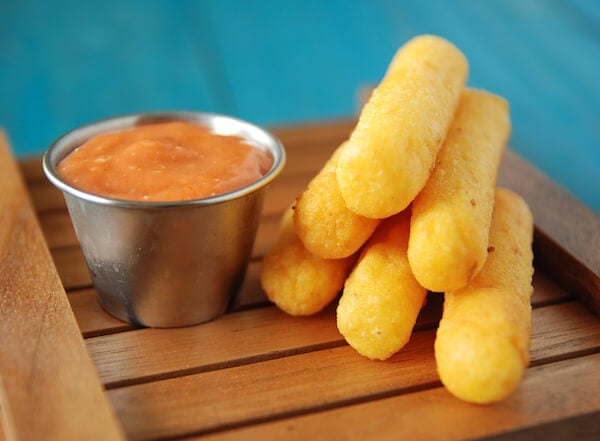
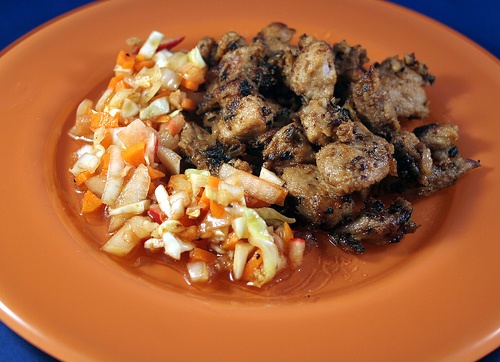
One of the country's best known appetizers is the Haitian patty (pate), which are made with round beef, salted cod (bacalao), smoked herring (food), chicken, and ground turkey surrounded by a crispy or flaky crust. Other snacks include akra (crispy, spicy fried malanga fritters), bananes pesées, and marinad (fried savory dough balls). For a complete meal, they may be served with griyo (fried pork) or other fried meat. These foods are served with a spicy slaw called pikliz which consists of cabbage, carrot, vinegar, scotch bonnet pepper, and spices. Fried foods, collectively known as fritay, are sold widely on the streets.
Regional dishes also exist throughout Haiti. In the area around Jérémie, on Haiti's southwest tip, people eat a dish called tonmtonm, which is steamed breadfruit (lam veritab) mashed in a pilon, and is very similar to West African Fufu. Tonmtonm is swallowed without chewing, using a slippery sauce made of okra (kalalou in Haitian Creole), cooked with meat, fish, crab, and savory spices. Another regional dish is poul ak nwa (chicken with cashew nuts), which is from the north of the country, in the area around Cap-Haïtien.
Waves of migration have also influenced Haitian cuisine. For example, immigrants from Lebanon and Syria brought kibbeh, which has been adopted into Haitian cuisine.
The flavor base of much Haitian cooking is epis, a combination sauce made from cooked peppers, garlic, and herbs, particularly green onions, thyme, and parsley. It is used as a basic condiment for rice and beans and is also used in stews and soups.

Increasingly, imported Maggi bouillon cubes are used by Haitian cooks.[16] This is indicative of the growing availability of imported, often artificial and inexpensive, foods, such as Tampico beverages.
Haitian Food Recipes

Haitian Food Recipes

Haitian Food Recipes

Haitian Food Recipes

Haitian Food Recipes

Haitian Food Recipes

Haitian Food Recipes

Haitian Food Recipes
Haitian Food Recipes

Haitian Food Recipes

Haitian Food Recipes

Haitian Food Recipes

Haitian Food Recipes

Haitian Food Recipes

Haitian Food Recipes

Haitian Food Recipes

Haitian Food Recipes
Tuesday, 16 June 2015

Vegan Food Recipes
Vegan Food Recipes
Biography Source google.com.pk
Vegan Cuisine
Vegan cuisine uses no animal products, such as meat, dairy, or eggs. This is more restrictive than vegetarian cuisine, which allows non-meat animal products. All vegan recipes are therefore vegetarian, though not all vegetarian meals are vegan. See Wikipedia's Veganism article for reasons why people are vegan, the history of veganism, and other vegan-related information.
Vegans should be attentive to their intake of vitamins B (especially B12) and D, calcium, iodine, and fatty acids. The Vegan Society's nutrition pages have more detailed information on this subject. See also Vegan nutrition on Wikipedia.
When preparing non-vegan recipes in accordance with a vegan diet, meat, eggs, honey, and dairy are replaced with a substitute ingredient. Substitute ingredients try to replicate the taste and texture of an ingredient or its other useful properties. Substituting for an ingredient works to greater or lesser degrees, depending upon the recipe, and some ingredients are almost impossible to replace. For more information see Vegan Substitutions.
Many vegans choose to avoid specialty substitute ingredients, as these products are often highly processed and high in sodium and allergen ingredients. Cooking with wholefoods such as unprocessed legumes, grains, nuts, seeds, fruits and vegetables can be a healthier approach to veganism. Many non-vegans will also enjoy these foods. Vegans often find that cooking 'real' foods rather than substitutes result in higher quality, better tasting meals that appeal to vegans and non-vegans alike.
Vegan Recipes[edit]
Breakfast[edit]
Porridge Tofu Scramble Oven pancakes Pancakes Tofu Bacon French toast
Beverages[edit]
Milks (Nut, Grain and Legume Liquids)[edit]
Almond milk Coconut milk Hazelnut milk Hemp milk Horchata, made from rice, almonds, or chufa. Oat milk Peanut milk Rice Milk Sesame milk Soy milk
Juices[edit]
Orange Carrot Juice Wheat grass juice Tomato juice
Spreads[edit]
Carrot Paprika Spread Spring Onion Spelt Spread Rice Wheat Spread Bean Spelt Oat Spread Spicy Carrot Aioli Vegan "Patte" Vegan mayonnaise
Cheese[edit]
Cheddar (Vegan) Coconut Brie (Vegan)
Sauces[edit]
Mjeddrah Peanut Sauce (Vegan) Puttanesca Sauce (Vegan) Eärgon Salsa
Components[edit]
Recipes used as components to many other recipes.
Preserved Lemon Seitan Ground Tofu
Vegan Bratwurst[edit]
Seitan Bratwurst Vegan Paprika Bratwurst Falafel Seitan Bratwurst
Appetizers and Sides
Baba ganoush Guacamole Hummus Tabouli Salsa
Soups
Keralan vegetable stew, often served with Appam Lentil soup Vegetable Stew and Dumplings Brazilian Black Bean Soup
Bread
Hard Tack Whole Wheat Bread (Vegan)
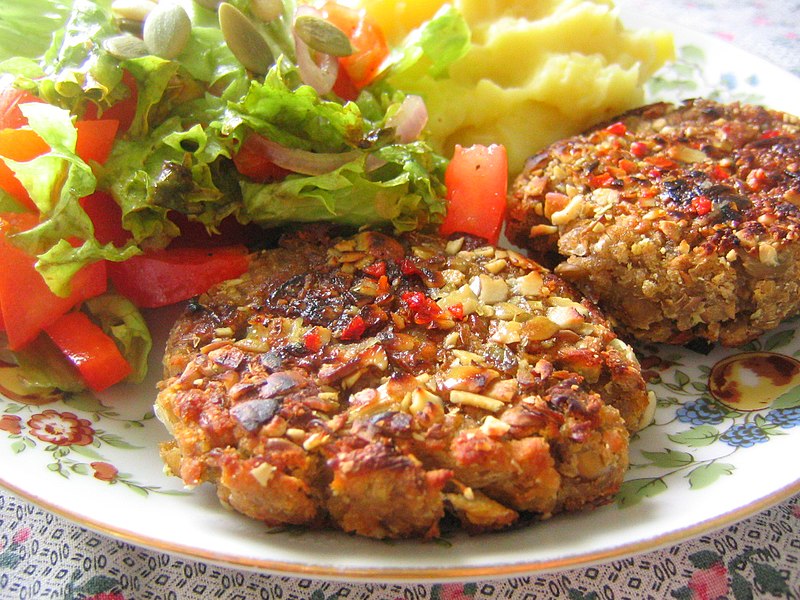
Vegan Patties
Spelt-Cutlet with Corn, Onion & Smoked Tofu
Hint: Some of the burgers could be seen to benefit from a higher amount of dietary fiber.
Spelt Burger Semolina Burger (with breading) Bean-Semolina Burger (with breading) Rice-Oat-Semolina Burger Bulgher Burger Seitan Burger (with breading) Potato Spelt Oat Burger
Mains
Ale, Mustard and Winter Vegetable Pie Appam, often served with Keralan vegetable stew Black-Eyed Peas and Kale Basic Indian Tomato Gravy (curry base) Bean Chili Chili (Vegan) Coconut Chutney Grilled Vegetable Sandwich Eggplant and Chickpea Skillet English Field Bean Pate Fried Rice Indian Beans Indian Potatoes Indian Rice Macaroni & Nutritional Yeast Masala Dosa (Dosa with Aloo Masala) Mike's Bean and Rice Bake Mike's Saffron Rice and Beans Mung Beans and Brown Rice Pandora's Feast Pasta e Fagioli Pecan Spinach Pasta Polenta Potato-Chickpea Curry Puliyodarai Pulse Chutney Ratatouille Rice an' Peas Samosa Stuffed Kabocha Squash Tadka dhal Tandoori Tofu Tofu Pancake Upeseru and Mudde
Desserts
Cupcake Mix

Anarchist Oatmeal Cookies Chocolate Chip Cookies (Vegan) Chocolate Mousse Cake Caramel Sauce Vanilla Caramel Sexy Cupcake
Vegan Food Recipes

Vegan Food Recipes

Vegan Food Recipes

Vegan Food Recipes
Vegan Food Recipes
Vegan Food Recipes

Vegan Food Recipes

Vegan Food Recipes
Vegan Food Recipes

Vegan Food Recipes

Vegan Food Recipes

Vegan Food Recipes

Vegan Food Recipes

Vegan Food Recipes

Vegan Food Recipes

Vegan Food Recipes

Vegan Food Recipes

Puerto Rican Food Recipes

Puerto Rican Food Recipes
Biography Source google.com.pk
TRADITIONAL PUERTO RICAN RECIPES
Thinkstock
The Puerto Rican Day Parade in New York City offers the perfect opportunity to celebrate the bounty of Puerto Rican cuisine. If you've ever had Latin food from the Caribbean, you know just how delectable traditional dishes can be, and you just might find something familiar here to re-create in your home kitchen.
From rich holiday foods like roasted pork shoulder (pernil) and the eggnog-like coquito cocktail, to lighter, summer-inspired dishes like Puerto Rican potato salad or asopao with shrimp and vegetables, to modern takes on dessert classics like mango vanilla cream piraguas and coquito cupcakes, we've found some of the best Puerto Rican recipes that you're sure to enjoy. Here's 18 irresistible dishes to help you wave the flag -- from the streets of New York City and beyond.
Margarita Crisp Ice Cream Cake
Recipe Submitted By Carolyng Gomes
Margarita Crisp Ice Cream Cake
The Margarita Crisp Ice Cream Cake layers salted phyllo dough with vanilla ice cream spiked with fresh lime juice, tequila and triple sec so each bite tastes like the beloved summer cocktail.
INGREDIENTS
For the Salted Phyllo Dough
1
16-ounce package phyllo dough
2
tablespoons
coconut oil, melted
2
tablespoons
coarse sea salt
For the Margarita Ice Cream
1
gallon
premium vanilla ice cream
1
shot
fresh lime juice
1/2
shot
tequila
1/2
shot
Triple Sec
zest of 1 lime
Additional Ingredients
peel of 1 lime, cut into strips
tablespoon sugar
zest of 1 lime
DIRECTIONS
Make the phyllo dough: Preheat oven to 350F. Grease 7-inch round springform pan with coconut oil and set aside. Brush phyllo dough with coconut oil and sprinkle evenly with salt. Cut out 2 7-inch rounds, place on a baking sheet fitted with a baking mat and bake for 15 minutes, or until crisp and golden. Set aside until cool.
Make the ice cream: mix all ingredients in a large bowl. Mix until thoroughly combined, then transfer to freezer to set.
Assemble cake: Place one round of phyllo dough in bottom of springform pan. Top with half of Margarita Ice Cream and transfer to freezer to set. Top with remaining phyllo dough and remaining Margarita Ice Cream, then freeze until solid.

To serve: Shake lime peel curls in sugar until covered. Set aside. Place a knife in hot water and trace edge of cake to free from form. Garnish cake with lime zest and lime curls, then unclip form, slice and enjoy!
Puerto Rican Food Recipes

Puerto Rican Food Recipes

Puerto Rican Food Recipes

Puerto Rican Food Recipes

Puerto Rican Food Recipes

Puerto Rican Food Recipes

Puerto Rican Food Recipes

Puerto Rican Food Recipes

Puerto Rican Food Recipes

Puerto Rican Food Recipes

Puerto Rican Food Recipes

Puerto Rican Food Recipes

Puerto Rican Food Recipes

Puerto Rican Food Recipes

Puerto Rican Food Recipes

Puerto Rican Food Recipes

Puerto Rican Food Recipes

Great Food Recipes

Great Food Recipes
Biography Source google.com.pk
A recipe is a set of instructions that describes how to prepare or make something, especially a culinary dish. It is also used in medicine or in information technology (user acceptance). A doctor will usually begin a prescription with recipe, usually abbreviated to Rx or an equivalent symbol.
Early examples
Apicius, De re culinaria, an early collection of recipes.
The earliest known recipes date from approximately 1600 BC and come from an Akkadian tablet from southern Babylonia.[1] There are also ancient Egyptian hieroglyphics depicting the preparation of food.[2]
Many ancient Greek recipes are known. Mithaecus's cookbook was an early one, but most of it has been lost; Athenaeus quotes one short recipe in his Deipnosophistae. Athenaeus mentions many other cookbooks, all of them lost.
Roman recipes are known starting in the 2nd century BCE with Cato the Elder's De Agri Cultura. Many other authors of this period described eastern Mediterranean cooking in Greek and in Latin. Some Punic recipes are known in Greek and Latin translation.
The large collection of recipes conventionally entitled 'Apicius' appeared in the 4th or 5th century and is the only more or less complete surviving cookbook from the classical world.[3] It lists the courses served in a meal as 'Gustatio' (appetizer), 'Primae Mensae' (main course) and 'Secundae Mensae' (dessert).
Arabic recipes are documented starting in the 10th century; see al-Warraq and al-Baghdadi.
King Richard II of England commissioned a recipe book called Forme of Cury in 1390,[5] and around the same time another book was published entitled Curye on Inglish.[6] Both books give an impression of how food was prepared and served in the noble classes of England at that time. The luxurious taste of the aristocracy in the Early Modern Period brought with it the start of what can be called the modern recipe book. By the 15th century, numerous manuscripts were appearing detailing the recipes of the day. Many of these manuscripts give very good information and record the re-discovery of many herbs and spices including coriander, parsley, basil and rosemary, many of which had been brought back from the Crusades.
Modern recipes and cooking advice
With the advent of the printing press in the 16th and 17th centuries, numerous books were written on how to manage households and prepare food. In Holland[8] and England[9] competition grew between the noble families as to who could prepare the most lavish banquet. By the 1660s, cookery had progressed to an art form and good cooks were in demand. Many of them published their own books detailing their recipes in competition with their rivals. Many of these books have now been translated and are available online.
By the 19th century, the Victorian preoccupation for domestic respectability brought about the emergence of cookery writing in its modern form. Although eclipsed in fame and regard by Isabella Beeton, the first modern cookery writer and compiler of recipes for the home was Eliza Acton. Her pioneering cookbook, Modern Cookery for Private Families published in 1845, was aimed at the domestic reader rather than the professional cook or chef. This was immensely influential, establishing the format for modern writing about cookery. It introduced the now-universal practice of listing the ingredients and suggested cooking times with each recipe. It included the first recipe for Brussels sprouts. Contemporary chef Delia Smith called Acton "the best writer of recipes in the English language." Modern Cookery long survived Acton, remaining in print until 1914 and available more recently in facsimile.
Titlepage of Beeton's Book of Household Management
Acton's work was an important influence on Isabella Beeton,[14] who published Mrs Beeton's Book of Household Management in 24 monthly parts between 1857 and 1861. This was a guide to running a Victorian household, with advice on fashion, child care, animal husbandry, poisons, the management of servants, science, religion, and industrialism.[15][16] Of the 1,112 pages, over 900 contained recipes. Most were illustrated with coloured engravings. It is said that many of the recipes were plagiarised from earlier writers such as Acton, but the Beetons never claimed that the book's contents were original. It was intended as a reliable guide for the aspirant middle classes.

The American cook Fannie Farmer (1857–1915) published in 1896 her famous work The Boston Cooking School Cookbook which contained some 1,849 recipes.[
Bourbon Chicken
Recipe Box Grocery List Print    
TOTAL TIME
35mins
PREP 15 MINS
COOK 20 MINS
I searched and finally found this recipe on the internet. It is a copycat of the Bourbon Chicken sold in Chinese carry-outs in my hometown. This recipe is so good that my sons gobble it up leaving me just a spoonful. Their excuse was they thought I had eaten. Editor's Note: Named Bourbon Chicken because it was supposedly created by a Chinese cook who worked in a restaurant on Bourbon Street.
Skip to Next Recipe
INGREDIENTS Nutrition
SERVINGS 4 UNITS US
2 lbs boneless chicken breasts, cut into bite-size pieces
1 -2 tablespoon olive oil
1 garlic clove, crushed
1⁄4 teaspoon ginger
3⁄4 teaspoon crushed red pepper flakes
1⁄4 cup apple juice
1⁄3 cup light brown sugar
2 tablespoons ketchup
1 tablespoon cider vinegar
1⁄2 cup water
1⁄3 cup soy sauce
DIRECTIONS
Editor's Note: Named Bourbon Chicken because it was supposedly created by a Chinese cook who worked in a restaurant on Bourbon Street.
Heat oil in a large skillet.
Add chicken pieces and cook until lightly browned.
Remove chicken.
Add remaining ingredients, heating over medium Heat until well mixed and dissolved.
Add chicken and bring to a hard boil.
Reduce heat and simmer for 20 minutes.

Serve over hot rice and ENJOY.
Great Food Recipes

Great Food Recipes

Great Food Recipes

Great Food Recipes

Great Food Recipes

Great Food Recipes

Great Food Recipes

Great Food Recipes

Great Food Recipes

Great Food Recipes

Great Food Recipes

Great Food Recipes
Great Food Recipes

Great Food Recipes

Great Food Recipes

Great Food Recipes

Great Food Recipes